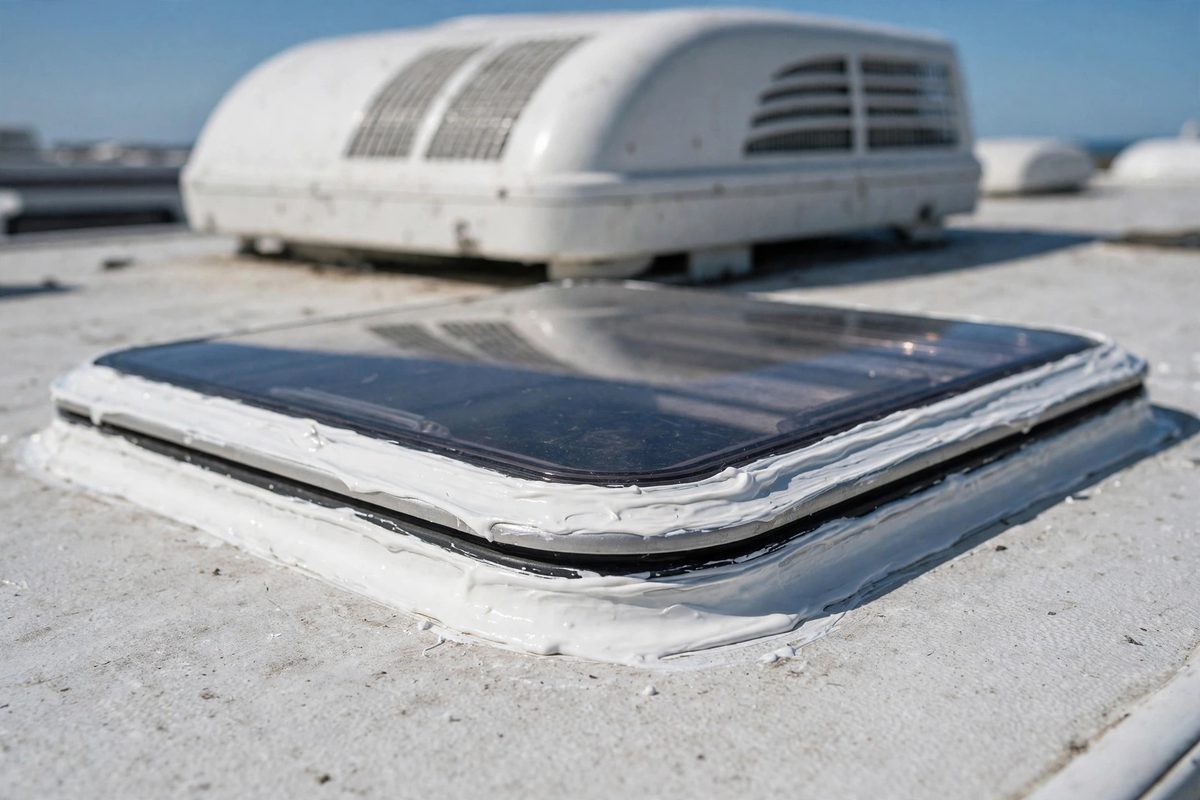
What usually fails
A Florida RV roof fights sun for eleven months and water for all twelve. The failure list is short and repeating:
- Sealant at the end of its life — lap sealant around vents, skylights, antennas, and cap seams cracks and lifts under UV; then the rainy season's daily downpours and wind-driven rain do the auditing.
- Ponding water — flat sections and low spots hold water after every storm, and standing water finds pinholes that shedding water never would.
- Membrane damage — low branches on oak-lined park roads, storm debris, and wear at ladder and walk paths tear or thin the membrane itself.
- AC gasket leaks — the roof AC's mounting gasket compresses and ages; the drip inside gets blamed on the AC, but the fix is at the roof.
- Leaks that present far from their source — water enters at a seam and travels; the ceiling stain is evidence, not the address. Florida's humidity then turns a hidden leak into mold before the stain is even noticed.
Symptoms worth calling about
- Drips or stains on the ceiling, especially after storms
- Soft or spongy spots when walking the roof
- Cracked, separated, or missing sealant at any penetration
- Musty smell that won't leave, or visible mold at ceiling corners
- Bubbling, lifting, or torn membrane
What a mobile tech can and can't do on site
On site: full roof inspection with photos, spot and full reseals, membrane patch and section repair, AC gasket replacement, vent and skylight replacement, and moisture assessment of what's underneath. Recoating systems can also be applied on site in the right weather window.
Honest limits: rotted roof decking across large areas, and full roof replacement, are bigger jobs — some are done mobile over multiple visits, some belong in a shop. What's certain: a reseal over a wet, rotted deck is money thrown away, and a good tech inspects before quoting. Our guide to what roof repair and reseal costs in Florida explains how the scope ladder works, and the rainy-season roof & seal guide covers the inspection rhythm that keeps you off the expensive rungs.
Have this ready when you reach out
- Roof material if you know it (rubber/EPDM, TPO, fiberglass)
- Where the water shows up inside, and when (every rain? only wind-driven rain?)
- Any previous patches — especially hardware-store silicone, which changes the prep work
- RV year/make/model, where it's parked, and whether roof access there is practical
Other services
Learn more →
Learn more →
Learn more →
Learn more →
Learn more →
Learn more →
Learn more →
Learn more →
Get a mobile tech to look at it
Tell us what's happening and where the RV is parked, and we'll match you with one local mobile technician for your area — not a shared list of companies.
Educational note: any cost ranges mentioned on this site are typical, general information only. Your technician confirms the service-call fee and an exact quote directly with you before work begins.