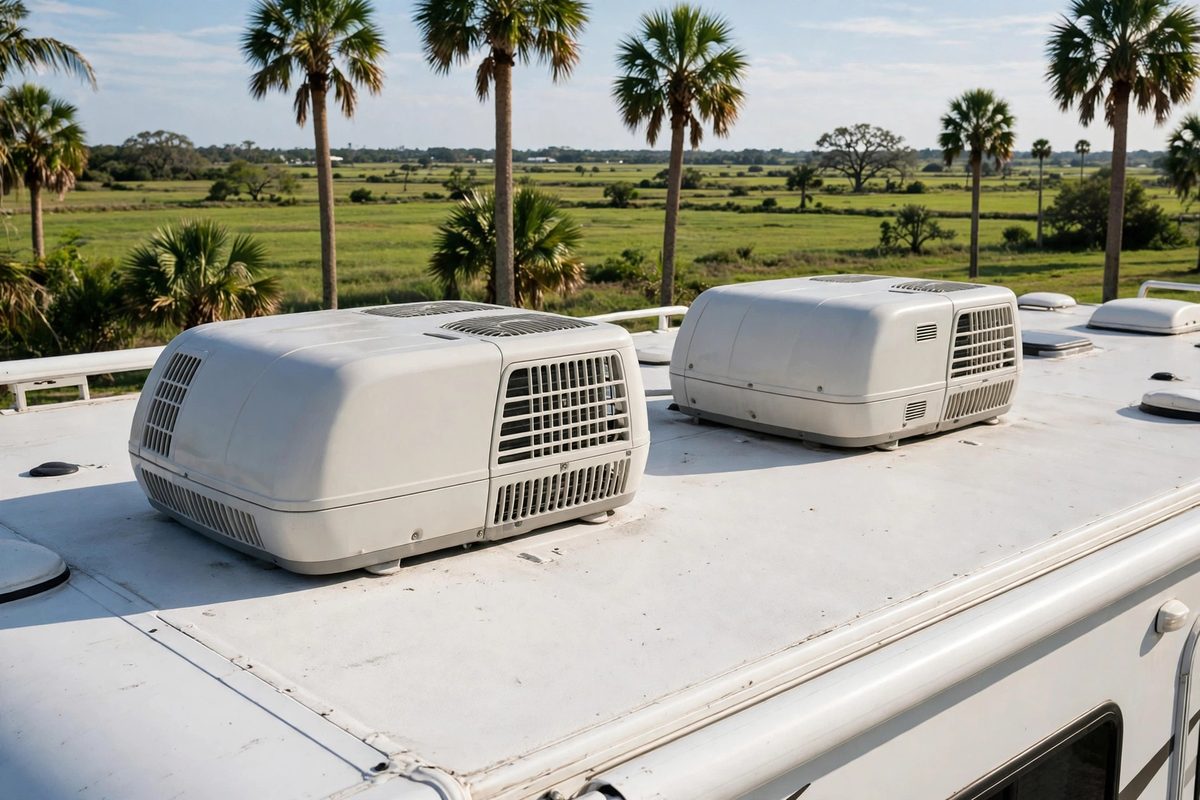
What usually fails
Most RV roof air conditioners (Dometic and Coleman are the common brands) die from a short list of causes — and Florida's heat and humidity push every one of them harder than almost anywhere else in the country, because the units run more months of the year here:
- Start and run capacitors — the classic failure. Heat is brutal on capacitors, and the AC hums, clicks, or trips the breaker instead of starting the compressor.
- Clogged condensate drains — the Florida specialty. Humidity means a roof AC produces a steady stream of water; algae and debris clog the drain, and the water ends up dripping inside from the ceiling instead.
- Dirty coils and filters — pollen, oak debris, and humidity-fed grime coat the coils; the unit runs longer and hotter for the same cooling until something gives up. A starved evaporator coil can also ice up in humid weather.
- Fan motor failure — months of maximum-load runtime wear them out; squealing, grinding, or a fan that won't spin even with a push.
- Control board or thermostat faults — the unit ignores the thermostat, short-cycles, or runs the fan but never the compressor. Humidity corrodes board connections over time.
- Low or lost refrigerant charge — RV roof units are sealed systems; a leak usually means the unit is near end of life rather than a cheap recharge.
- Shore power problems — low voltage at a loaded resort pedestal on a hot afternoon, or a tired breaker, can look exactly like a dead AC.
Symptoms worth calling about
- AC blows warm or room-temperature air
- Breaker trips when the compressor kicks on
- Unit hums but never starts; fan runs but no cooling
- Interior temperature climbing even with the AC running flat out
- Water dripping inside from the ceiling (often a clogged drain or gasket issue, not the AC itself)
- AC works on generator but not on shore power (or the reverse)
What a mobile tech can and can't do on site
On site: full electrical testing (capacitors, contactors, control boards), coil and filter cleaning, drain clearing, thermostat replacement, fan motor swaps, start-capacitor replacement, checking your shore-power voltage under load, and complete unit replacement in many cases — a new roof unit can typically be installed right where the rig is parked.
Honest limits: sealed refrigerant systems on RV roof ACs are not practically rechargeable the way a home AC is — if the diagnosis is lost charge from a leak, replacement is usually the real conversation, and the tech should explain why rather than sell a recharge. Rooftop work also depends on safe roof access and workable weather — nobody should be on a roof in a thunderstorm cell, and a good tech will schedule around Florida's afternoon storms.
Before it fails: caring for a roof AC in Florida heat and humidity
Most of the failures above are preceded by a season of strain — clogged filters, dirty coils, drains growing shut, and low pedestal voltage. Our owner's guide to keeping an RV AC alive in Florida heat and humidity covers the cleaning, drainage, and power habits that keep a roof unit alive through a Florida summer, and the warning signs that appear before it quits.
Have this ready when you reach out
- AC brand and model if you can read the label (a photo of the ceiling assembly helps)
- Does the fan run? Does the compressor try to start? Any breaker tripping?
- Are you on shore power, generator, or both — and did it fail on both?
- RV year/make/model, where it's parked (resort + site number, home, or storage), and whether you have one roof AC or two
Other services
Learn more →
Learn more →
Learn more →
Learn more →
Learn more →
Learn more →
Learn more →
Learn more →
Get a mobile tech to look at it
Tell us what's happening and where the RV is parked, and we'll match you with one local mobile technician for your area — not a shared list of companies.
Educational note: any cost ranges mentioned on this site are typical, general information only. Your technician confirms the service-call fee and an exact quote directly with you before work begins.